
20 years Infrared opticsProfessional plastic manufacturer
Equity code of enterprises listed on the New Fourth Board of Guangzhou equity trading center: 891135
National hotline:400-0308-668Equity code of enterprises listed on the New Fourth Board of Guangzhou equity trading center: 891135
National hotline:400-0308-668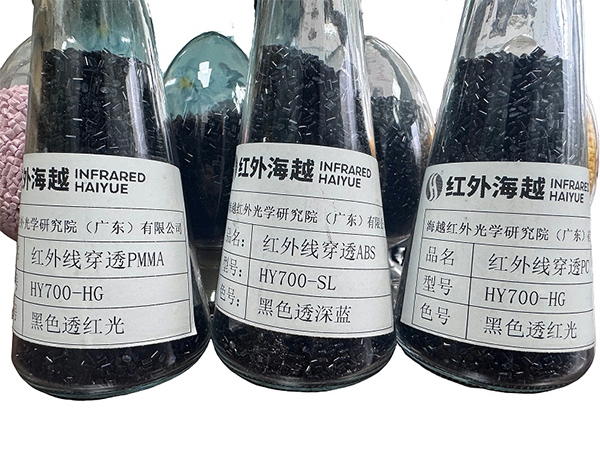
In today's era of rapid technological development, infrared technology has been widely applied in various aspects of life, ranging from smart homes to industrial automation, from security monitoring to medical equipment. As the key foundation for realizing infrared functions, infrared penetrating high molecular materials is playing an increasingly important role. Among them, special optical plastics such as PC (polycarbonate), PMMA (polymethyl methacrylate), and ABS (acrylonitrile-butadiene-styrene copolymer) have become common materials in the field of infrared applications due to their unique performance advantages.
PC is a transparent engineering plastic with excellent comprehensive performance, and it exhibits outstanding performance in infrared penetration. Infrared penetration of PC is usually a special black optical-grade material. It has a high degree of penetration ability for near-infrared rays, while it has good shielding properties for visible light and mid-to-long infrared rays. This material is based on polycarbonate plastic and is formed through the addition of infrared agents and other additives, and through a special process of polymerization. During the processing, by adjusting the material ratio, both the inherent characteristics of polycarbonate plastic and the efficiency of infrared penetration can be maintained, and the performance of infrared penetration can also be enhanced.
In the field of automotive laser radar, PC materials have achieved remarkable success. When a 1550-nanometer laser beam penetrates the components made of PC, the light transmittance can reach over 90%, and it can precisely filter out 90% of the 905-nanometer wavelength laser, eliminating over 90% of the interfering light. Even in a blizzard at minus 40 degrees Celsius, it can maintain a thermal expansion stability of 0.3 millimeters. When the laser beam penetrates at an 15-degree incidence angle, the nano-scale coating on the material surface can control the refractive loss within 0.2% and provide a strong guarantee for the reliability of the autonomous driving system. In smart panels of smart homes, transparent PC materials also play an important role. Their core characteristic lies in being able to transmit infrared light, with a transmittance of over 90% in the infrared nanometer band (850 - 1100nm), enabling the control panel to accurately receive the infrared signals sent by users and achieve precise control of devices such as curtain opening and closing.
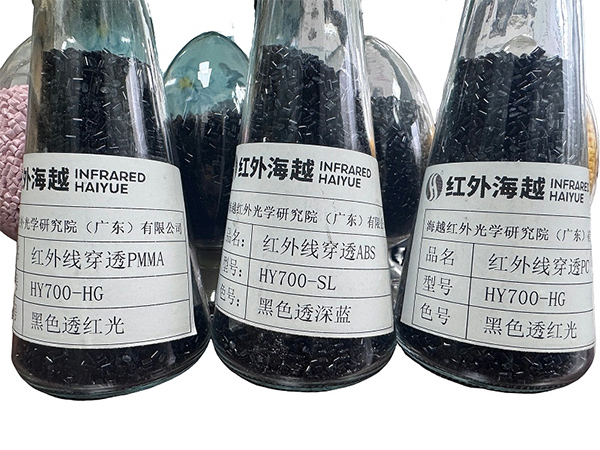
PMMA is commonly known as plexiglass and is one of the plastics with the best optical properties. The infrared transmission property of PMMA is very high, and it has outstanding anti-aging and erosion resistance, as well as excellent insulation and processing capabilities. This material is a non-crystalline polymer. Manufacturers often enhance its toughness by increasing the tensile strength. Currently, its toughness has been significantly improved, and after the surface is treated, its impact resistance can also be greatly enhanced.
In the manufacturing of night vision camera lenses for security surveillance, transparent PMMA materials for infrared transmission have become the preferred choice. Their excellent infrared light transmission properties ensure the stable transmission of sensor signals, while the high transparency and excellent surface hardness inherited from PMMA materials effectively resist scratches and wear, thereby extending the lifespan of the lenses. In the manufacturing of the non-contact body temperature detection shells for medical equipment, transparent PMMA for infrared transmission not only meets the sterilization requirements of medical devices but also ensures the accuracy of temperature measurement. Moreover, in the fields of vehicles, military, and aerospace, infrared filters made of PMMA can filter out visible light when specific wavelength infrared light sources enter, resisting interference and protecting subsequent equipment or optical systems from damage.
Thermal infrared ABS is a modified engineering plastic. While retaining the original advantages of ABS, such as excellent mechanical strength and impact resistance, good processing fluidity, easy dyeing, and good surface gloss, it also increases the transmittance of infrared rays. It is widely used in the manufacturing of smart speaker shells. It enables infrared rays to pass through smoothly, allowing the infrared sensors inside the speaker to work normally without being blocked by the shell, enabling designers to integrate the infrared receiving window with the shell, avoiding the awkwardness of traditional designs that require opening holes on the speaker surface or setting obvious infrared windows. It effectively shields the electronic components inside the smart speaker, greatly enhancing the overall aesthetic appeal of the product.
On the TV set-top box, this material with infrared transmission properties also performs exceptionally well. Its infrared transmission rate can reach over 90%, far exceeding the general requirements. It can control the transmission rates of specific wavelengths such as R, G, and B, and can ensure that the light transmission rate is less than 0.1. The casing of the set-top box made of this material can completely withstand drops and collisions during daily use without cracking or splitting, protecting the safety of the internal electronic components of the set-top box and extending the product's service life. Moreover, it has good fluidity, is easy to be molded, has stable finished dimensions, and can effectively improve production efficiency.
Special optical plastics such as PC, PMMA, and ABS each excel in the field of infrared penetration. Leveraging their unique optical properties, mechanical properties, and excellent processing capabilities, they have been widely applied in numerous fields, driving the continuous development of infrared technology and providing strong support for the innovation and upgrading of various industries. With the continuous advancement of technology, these materials will also be continuously optimized and will play a greater role in more emerging fields.

Mobile site
WeChat public account
WeChat Mini Program
 WeChat
 WeChat